
Five key lessons after one year of OGD (Open Government Data) in the City of Zurich
This guest post was written by Claudia Hochstrasser, OGD project manager of the City of Zurich and consultant at the Zurich IT company itopia.
 The OGD portal of the City of Zurich went live last year on 28 June and has now been running successfully for over a year. Time to draw five key lessons from one year of OGD in the City of Zurich.
Key lesson one: OGD does not run by itself.
Launching a platform and publishing the first datasets is the first step towards OGD. However, the experience gained this year showed early on that this alone is not enough to successfully establish the continuous publication of government data and the long-term, sustainable continuation of OGD in operation. At the beginning of the year, the City of Zurich therefore developed a catalogue of 14 accompanying measures to promote and advance OGD both internally and externally, beyond simply launching the portal. Implementing these measures requires resources as well as dedicated staff with a range of skills.
Key lesson two: OGD as a project and OGD in operation are two different things.
Transferring OGD from a project into day-to-day operation proved to be a major challenge. In addition to building a central Open Data team and creating new internal roles, many operational processes that were of secondary importance during the development and launch of the portal have to be established.
An administration is a very heterogeneous organisation with different technical systems and levels of data maturity. Moreover, data management is often not the core business of the department or service unit. Suitable, individual data delivery processes and ways of charging for the resulting effort must therefore be set up internally in order to do justice to the various data suppliers. Among other things, the role of the OGD data steward was created for this purpose.
Such changes do not happen overnight. It takes time and patience for new processes to be established and lived in the organisation. A clear and solid legal basis helps decisively to remove uncertainties in this respect.
In addition, it quickly became clear in the City of Zurich that data and its management must be technically supported by the right infrastructure. A dedicated infrastructure will therefore be introduced by the end of the year, which will also enable data federation with the federal portal.
Key lesson three: OGD is communication, communication, communication.
Both internal and external communication play a decisive role in OGD. A large part of the Open Data team’s daily work therefore lies in this area. The role of community manager was created for exchanges with interested citizens. Twitter was identified as one of the main channels of the OGD community and was subsequently consistently set up and used internally. That another communication channel is needed alongside Twitter only became apparent during the course of the year.
A newsletter is therefore in preparation. It is intended to reach those interested parties who do not communicate via Twitter. In addition to looking after the Twitter account, the community manager’s tasks include running the Zurich OGD meetups and planning a municipal OGD competition, which will take place in October and November. The feedback process (answering enquiries, reporting errors) is also covered by the community manager.
Within the city, a great deal of awareness-raising is also needed to bring OGD closer to other service units and departments. With the creation of internal information material, an important measure has been implemented here. Workshops are also held regularly to anchor OGD more firmly within the administration.
Key lesson four: A purely quantitative view of costs and benefits is not sufficient for OGD.
 In most cases, data is collected, analysed, published and then filed and archived internally. As a result, the potential and value that could be gained from this data is not fully exploited. By publishing the data for free re-use, part of this untapped potential can be put to use by the public sector.
Measuring a return with quantitative methods is not enough to obtain a complete picture of the benefits of OGD. Although the city knows the download figures of its datasets, little further information can be gathered about the secondary use of the data by third parties. The City of Zurich therefore depends on feedback from the interested public telling it how and in what form its open data has been incorporated into projects. However, it can be assumed that such feedback is only given for a fraction of the projects actually implemented with OGD.
To obtain a complete picture of the added value of OGD, further aspects of benefit must be taken into account.
In the City of Zurich, for example, providing government data is also actively pursued as a measure to promote the city as a location for young ICT companies. This year, the Open Data team has supported a number of young companies that want to implement their ideas with municipal data.
Exchange with the population and the promotion of its participation is another benefit that cannot be measured quantitatively. This goal is also being actively pursued within the framework of OGD through a series of communication activities.
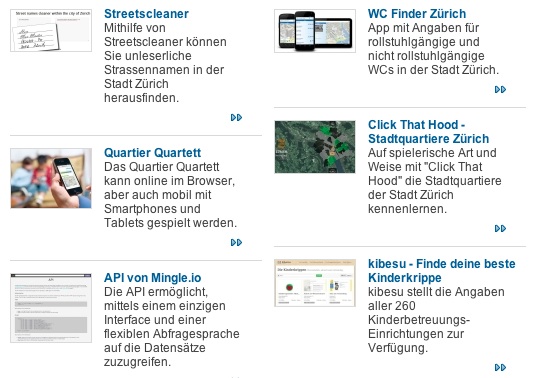
Applications developed with the help of OGD also generate an economic benefit: apps are created that make life easier for the population. The benefit of an application such as easily searching for and finding the nearest ZüriWC is easy to see, but it cannot be measured quantitatively either.
Last but not least, OGD also creates a cultural benefit. OGD theses at universities and OGD project weeks at cantonal secondary schools have already been carried out or are currently under way.
The view of OGD must therefore move away from a purely cost/benefit-oriented perspective towards a more comprehensive perspective of its benefits.
Key lesson five: OGD needs political support.
Above the OGD project and its operation, solid political support is a decisive precondition. For further data to be successfully opened up as OGD, the government needs to give the administration a clear mandate to publish its data as OGD by default. Accordingly, a sustainable budget must be secured for OGD in order to compensate not only for internal effort but also for lost revenue when data is released free of charge. OGD needs continuity; staying power is required internally and externally. Without the political will to really implement OGD, the project will therefore hardly be able to continue successfully in the long term.
Further information on the topic:
Just today (03.09.2013), the Tages-Anzeiger published an article on the OGD portal of the City of Zurich: ‘Zürich – die Pionierstadt der Open-Data-Bewegung’.
The Open Data Zürich Hacknights 2013 will take place on 15 and 29 October and 12 November 2013. You can sign up here.
The OGDZH Twitter account: @OpenDataZurich