Playful access to digital cultural heritage thanks to open cultural data and modern technology
On 27/28 February the first Swiss culture hackathon took place at the Swiss National Library in Bern. Developing new things together: that was the goal of the more than 100 programmers, artists, researchers from the digital humanities, Wikipedians, archivists and librarians who came together in Bern on the initiative of the OpenGLAM.ch working group.
Not least thanks to these different perspectives, the participants helped present the data provided by 20 Swiss memory institutions in entirely new ways. From the roughly 20 projects and applications that emerged, we have selected a few examples below:

In the project Diplomatic Documents and Swiss Newspapers in 1914 programmers, researchers and archivists linked datasets from the DODIS database and the Le Temps Historical Archive and visualised the connections on a map.
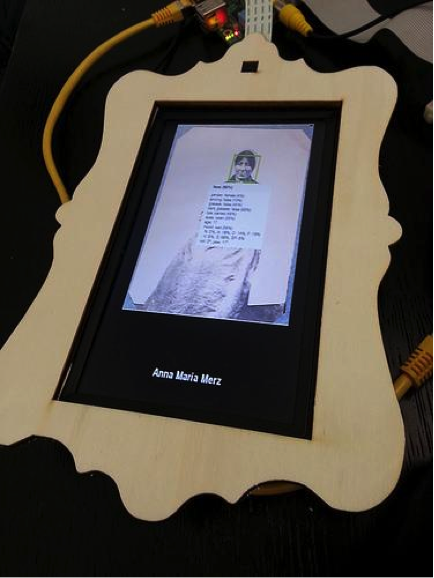
Police pictures of stateless people by the lithographer Carl Durheim (1810-1890), from the holdings of the Swiss Federal Archives, were the subject of several projects. For example, the makers of Picture this invented a picture frame that interacts with the viewer. The picture of a stateless person displayed in the frame reacts to the visitor’s gaze. The longer you look at the picture, the more information about the photograph appears. For example, the program shows the person’s name or place of birth. If you are patient enough, the application replaces the face in the photograph with your own face. Is this perhaps meant to symbolise empathy with the people depicted?
 Schweizer Kleinmeister: An Unexpected Journey shows the National Library’s valuable Gugelmann collection from an entirely new angle. In a three-dimensional space, the pictures are organised by subject, painting technique and author. The project is presented in a video and invites you on a journey of discovery.

Various projects were also realised for the Wikimedia platforms. One group of participants corrected and completed the list of national monuments on Wikidata, Wikipedia’s semantic database. In another project, historical photographs of the city of Zurich were published on Wikimedia Commons. These and similar data from Wikidata finally inspired the makers of the never-ending story.
Numerous other projects were realised during the two days of the hackathon and documented by the participants. The shared experience, the collaboration and the exchange of experience were at the heart of the hackathon. Most of the participants were attending an event of this kind for the first time and above all the creative and friendly atmosphere was greatly appreciated. At the same time, the event was an example of successful cooperation between memory institutions and the open data community. This created good conditions for giving the interested public playful access to Swiss cultural treasures.
Further information, a press review and pictures of the event can be found in the hackathon wiki. The organising committee can be reached by email at hackathon2015@openglam.ch.
Authors: Claudia Lienhard, Simon Meyer and Frédéric Noyer