OKCon 2013: only a brief pause after the great success
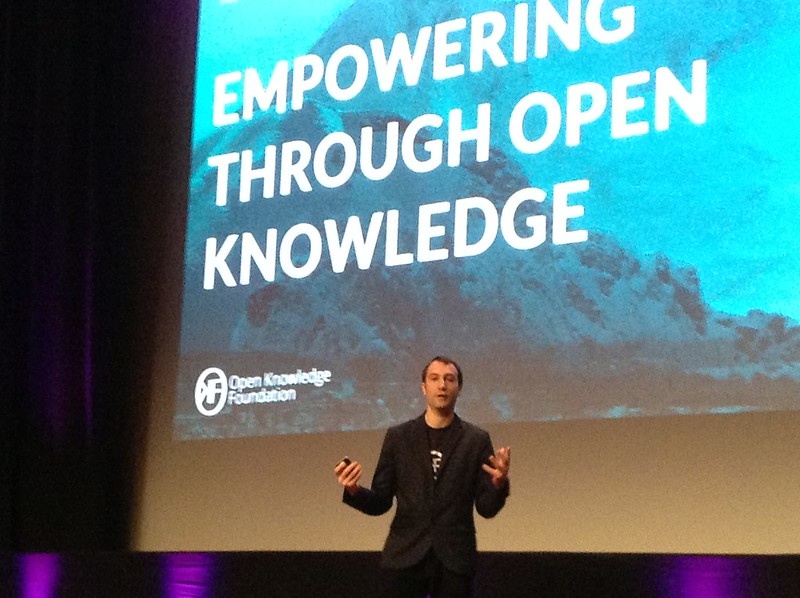
From 16 to 18 September, Geneva became the hub of the global open data movement. With over 900 registered visitors from more than 45 countries, the Open Knowledge Conference 2013 was a success on every level. The world’s most important open data event of the year prompted over 15,000 messages on Twitter, became a “trending topic” as far away as Washington and also caused a great stir in the national media. NZZ and Tages-Anzeiger, SonntagsZeitung and TagesWoche, 24heures and SRF were there and reported extensively.
The Swiss highlights certainly included the launch of the federal administration’s OGD pilot portal, as well as an impressive breadth and depth of expert contributions from institutions in Bern, Zurich and Geneva, not least the UN and CERN. The contributions by Ellen Miller and Jay Naidoo also attracted great international attention.
Jay Naidoo was one of Mandela’s companions and, as his Minister of Communications, played a decisive role in shaping the framework for the rapid growth of mobile telephony in Africa. Today he fights malnutrition and corruption, two closely linked evils.
In his summary, Naidoo speaks of his impressions of OKCon: “These are young digital warriors. They are connected. Their weapon is the internet. Their enemy is corruption. And they are here to bring a revolution of ethics into the 21st century.” – yet his talk itself is even more impressive:
Ellen Miller, executive director and co-founder of the Sunlight Foundation, the transparency organisation doing groundbreaking work in the USA, provided another highlight – the content of her presentation went around the world in no time via Twitter, Facebook and live stream. Miller spoke of the fundamental challenge for the state that she tackles through open government data, and of the crucial importance of the topic, which is far more than an IT or efficiency issue: this is not about “e-government” but about “we-government”!
Along with many other video recordings, Ellen Miller’s talk is already available online:
Representatives of Opendata.ch, which organised the event together with the international Open Knowledge Foundation, said they were overwhelmed by the days surrounding the conference: the decisions in Bern, the launch of opendata.admin.ch, the extensive media coverage and the intense conference in Geneva moved their cause forward by large and decisive steps in a short time.
André Golliez, President of Opendata.ch, stated:
“With OKCon 2013, open knowledge is also developing into a strong socio-political movement in Switzerland, spreading into all areas of public knowledge production and use: in public administration, in public-sector companies, in the media and in science, education and culture.”
Hannes Gassert, Vice-President of Opendata.ch, added:
“OKCon 2013 was not only the world’s most important open data event of the year, but also a milestone for open data – in Switzerland as well as for the global movement. The topic is firmly established at the United Nations in Geneva, in federal Bern and in the Swiss media. As an organisation, Opendata.ch is now tackling the next challenges greatly strengthened.”
While in Geneva the World Bank launched an extensive partnership for open data in developing countries, Bern did anything but stand still: two weeks after adopting the Riklin postulate, which calls for a master plan for open government, the National Council also dealt with the Graf-Litscher motion yesterday evening, 23 September 2013 – which calls for three concrete measures to open up the federal government’s data holdings – and approved it. The item now goes to the Council of States, where it is expected to be dealt with in the winter session.
Accordingly, there is little time to pause and look back on the great success: the open knowledge movement has now picked up full speed in Switzerland too. The first milestone is behind us, but it is only a beginning. Switzerland’s open government data strategy has to be defined, further events – such as the Open Data Zurich Hacknights – are coming up, and a multitude of stories want to be written. At stake is nothing less than the future nature of the information society, nothing less than a contemporary interpretation of transparency and participation.