
A boost for rail innovation – transport providers and the community at the same table
The call for open mobility, environmental, health, infrastructure and other government data, freely accessible to the public, gained further support last weekend. The Opendata.ch association had invited people to the 2nd Swiss Make.opendata.ch Hackdays in Zurich and Geneva, and 120 hackers, designers, politicians and experts came together to work, by means of benign “hacks”, on more efficient, more social – better – transport.
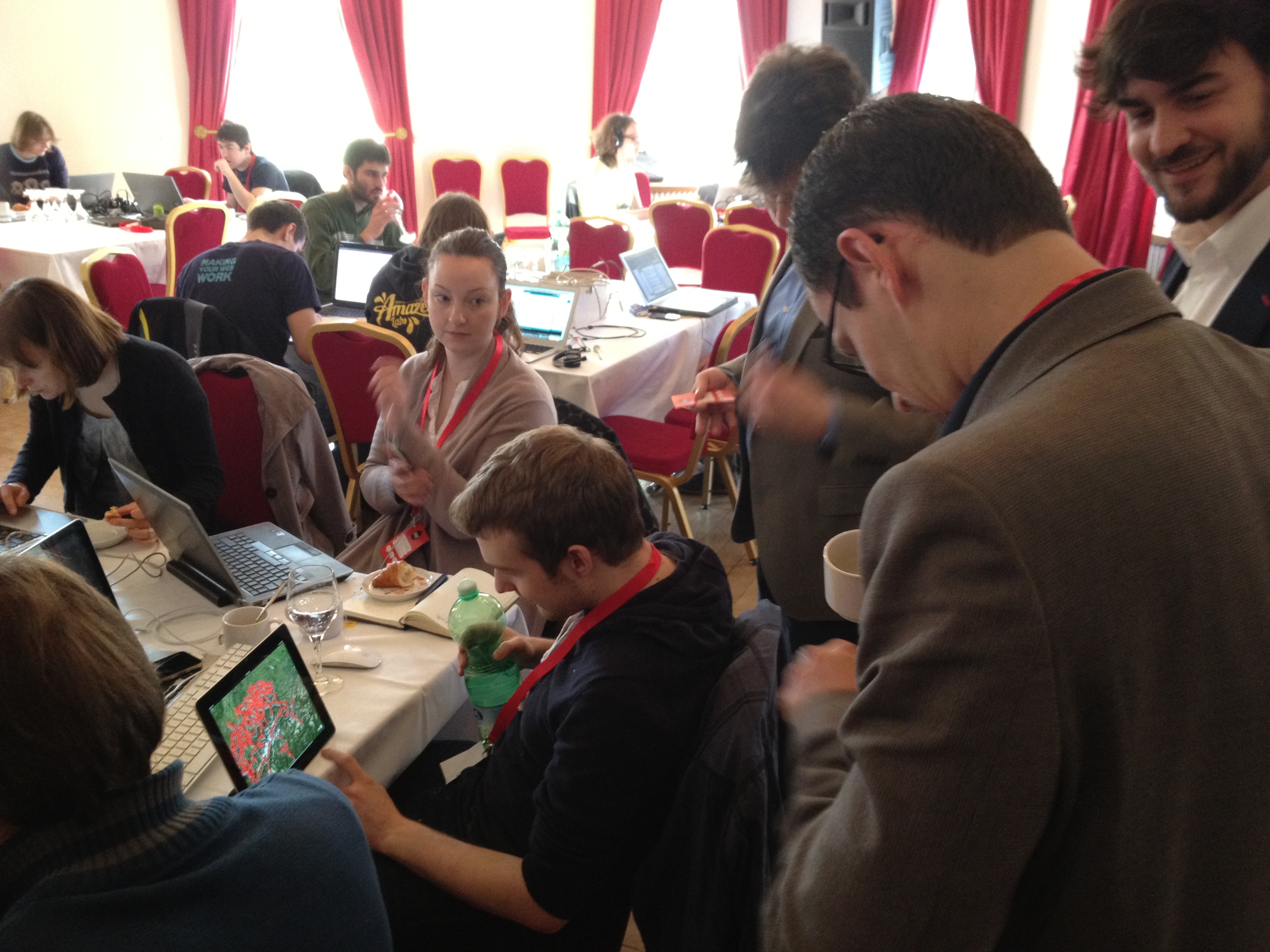 After the first, thematically open Make.opendata.ch Hackdays at the end of September 2011 in Zurich and Lausanne, this time the participants worked on applications and visualisations using public transport data. To further promote innovation in the field of mobility, the Opendata.ch association has published the “Swiss Public Transport” API.
Innovative applications and visualisations
The value of openly accessible data only becomes apparent to a wider public through applications and visualisations. The participants implemented the following projects in just under 24 hours:
 Swiss Public Transport API
This interface enables interested developers to build their own applications with public timetable data, whether on the web, on the desktop or on mobile devices. Building on the interface, the team has built a RealTime PubSub Engine for Opendata based on HTML5 Websockets and a Command Line Interface. Among other projects, the Rollstuhlkarte already uses the interface.
 Transport Flows: Based on Swisstrains.ch, this interactive visualisation impressively conveys the flows of public transport across the whole of Switzerland over the course of the day. At a glance it becomes clear where public transport pulses and how strongly.
 Tangible Statistics
Another way of making data tangible is to turn it into three-dimensional objects. The only limit is the imagination. Using a 3D printer, statistical data was given the shape of earrings, chess pieces or egg cups.
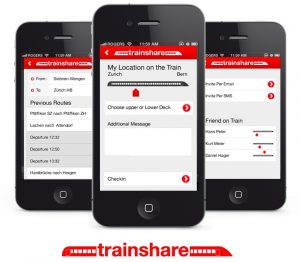 TrainSharingApp
More and more people commute. What if you could quickly and easily find out whether someone you know is sitting on the same train? And ideally where, too? That is exactly what the “TrainSharingApp”, which is close to completion, is for.
 GottaGo
Based on the idea of a bus stop lamp, “GottaGo” was developed as a universal tool that tells you, on various devices, the right time to leave for the bus, tram or train.
These are just some of the projects implemented at the event in Zurich. All project documentation and links to demos can be found here. At the same time, a whole host of applications and visualisations were also developed in Geneva (detailed information will follow in a separate blog post).
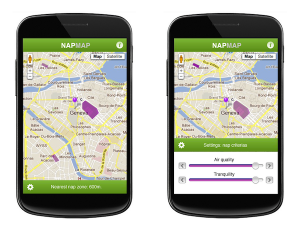 The city of Geneva already has a relatively extensive geoinformation data portal. One application that aims to use noise and air pollution data in an innovative way is the SiesteApp, which wants to suggest the nearest place for a quiet, healthy nap.
The participants’ commitment was high and demonstrated in Zurich and Geneva alike how public and private transport providers, high tech, design and democracy can come together productively.
Cooperation between authorities, private companies and the community
Representatives of SBB are also quite open to this commitment from the community. The statement by Patrick Comboeuf, Director E-Business of Swiss Federal Railways SBB, is an expression of the growing mutual trust:
The modalities of open access to public transport data (geodata, timetables etc.) will be discussed in depth with the various stakeholders over the coming months. Against this background, SBB also sees the make.opendata.ch events as a platform for dialogue to create the corresponding transparency.
Balthasar Glättli, National Councillor and member of the core team of the Parliamentary Group “Digital Sustainability”, visited the event in Zurich and supported the publication of the “Swiss Public Transport” API with the words:
If you don’t tickle a dinosaur’s feet, you’ll never know whether it smiles.
Further Hackdays and events follow in quick succession
 The Bern Make.opendata.ch Hackday takes place on 27 April. Registration for the half-day event is open here.
This year’s “Opendata.ch 2012” conference takes place in Zurich on 28 June. The host is the City of Zurich. Information and registration can be found here.
The next two-day Make.opendata.ch Hackdays take place on 28 and 29 September, this time on the topic of “health”. Interested authorities and private organisations wishing to make data available to the community are invited to get in touch with the Opendata.ch association (contact).
The organisers thank all participants and the sponsors internet-briefing.ch and VTX for their great support and look forward to the next steps towards more data democracy in Switzerland.
Media reports & blog posts:
- “Mehr offene Daten führen zu besserem Verkehr” (Netzwoche, 30.03.2012)
- “Daten für besseren Verkehr” (Leumund.ch, 31.03.2012)
- “Offene Daten: Was läuft in der Schweiz?” (Geo.ebp.ch, 02.04.2012)
- “Offene Daten für besseren Verkehr – Ergebnisse der Zürcher Make.opendata.ch-Hackdays” (Netzwoche, 03.04.2012)
- “Big leap forward for Opendata” (Liip Blog, 04.04.2012)
- “Werkstattbericht #1 – Projekt ‘Swiss Transportation Flows'” (NZZ Blog, 05.04.2012)
- “Einsteigen, umsteigen und ankommen. Unterwegs auf Europas dichtestem Bahnstreckennetz” (NZZ Online, 05.04.2012)