
5th National eGov Symposium: “The benefit of open government data appears when it is used”
This year’s gathering of Swiss e-government officials and interested parties revolved around “Open Government” and “Open Government Data (OGD)”. Both topics have – as the positive response to the Wasserfallen parliamentary motion at the Federal Council meeting on Wednesday before last also shows – arrived at the highest institutional levels of government and administration. This is thanks to the Swiss Opendata.ch community. Its active commitment as a partner in knowledge transfer, strategy and implementation is now needed all the more.
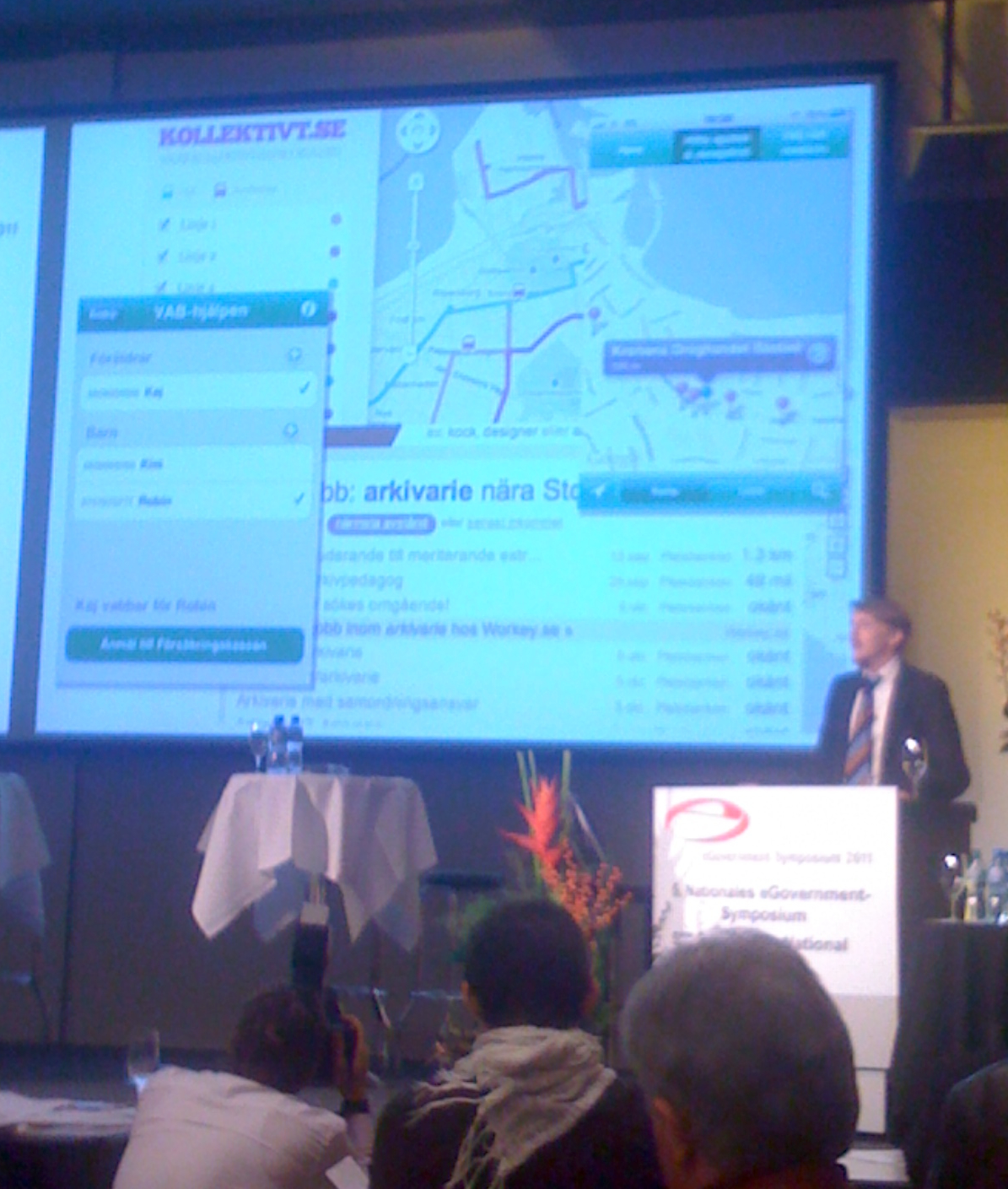
Encouraging (I): Peter Krantz, Swedish government, stresses the importance of the community.
Peter Fischer, Federal Council Delegate for IT Strategy, welcomed those present and handed over to Federal Councillor Eveline Widmer-Schlumpf. In her opening address the Federal Councillor expressed the intention of positioning OGD as a priority in Switzerland’s e-government strategy. Besides this positive statement, it was equally encouraging that she did not disappear straight back to the Finance Department, but stayed on site until midday and showed herself “open” and interested in the OGD experience of, for example, the Swedish government.
The representative of the Swedish e-government delegation and member of the “Digitalization Council”, Peter Krantz (who is also the source of the quote in the title), made a strong case for involving the community in both the design and the implementation of strategies and activities in the field of open government and, in particular, of OGD. In his – highly recommended – presentation Krantz gave a well-informed interim assessment of OGD in Sweden. He was pleased and indeed proud of the results, yet by no means concealed the challenges still ahead. Asked by the audience about the purpose of app contests as a means of actively involving the community, Krantz stressed that such contests – if they are meant as sincere promotional measures and are to show successful results beyond the event itself – should include, first, a thematic framing, second, support from the government and administration representatives involved with implementation and support, and third, financial support for apps from both private and public sources.
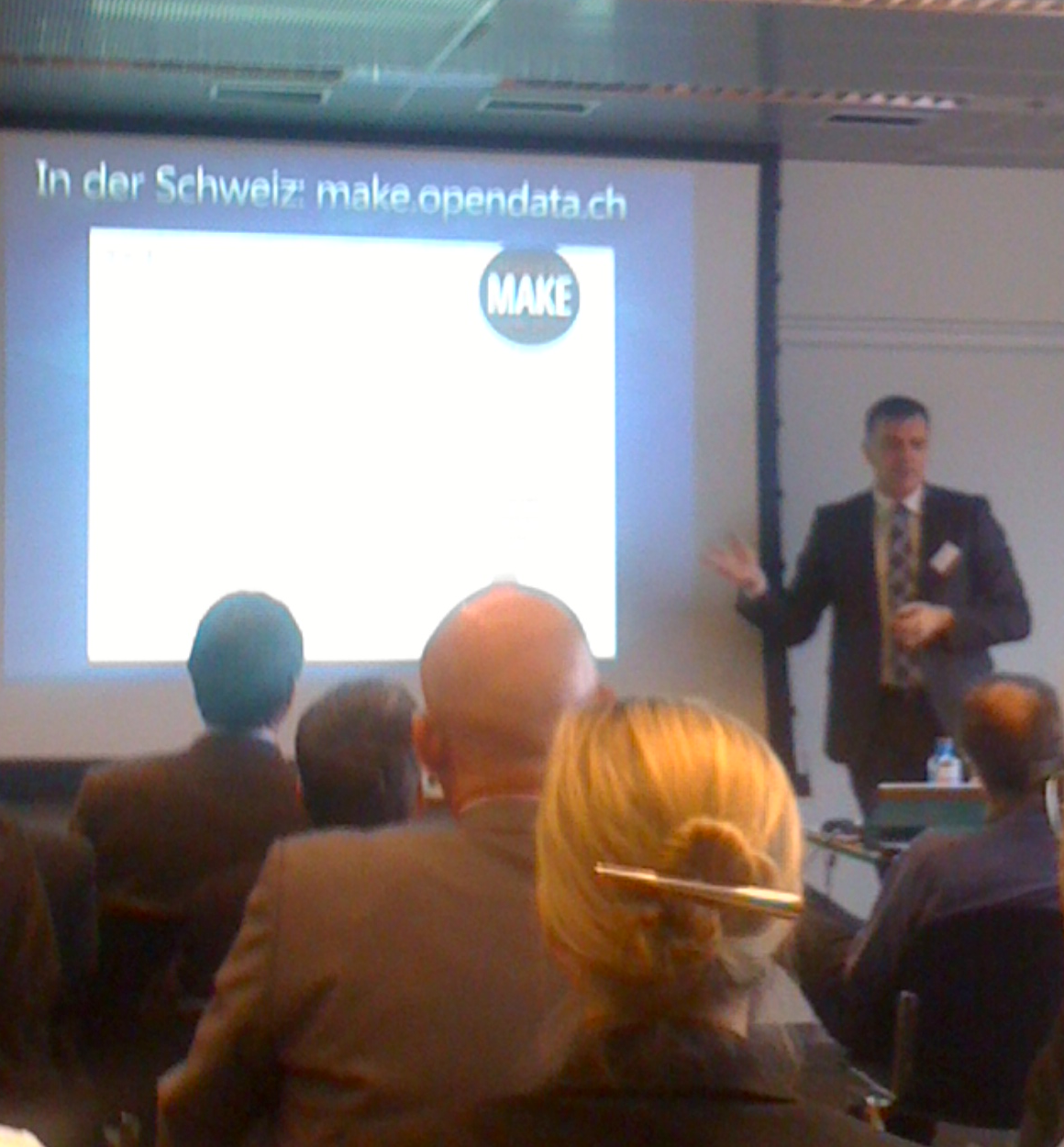
Encouraging (II): Reto Haeni, Microsoft Switzerland, in his search for OGD in Switzerland, reported primarily on Make.opendata.ch.
In the afternoon, according to the conference programme, the specialist session “Economic Innovation” was to open with Reto Haeni, Chief Security Advisor at Microsoft Switzerland, speaking on “Success factors for open government projects; experiences and challenges”. Unfortunately, he still seemed to lack in-depth experience with the subject, and when it came to challenges he focused – not surprisingly, given his field – exclusively on security aspects. Not only the few representatives of the OGD community present, but also the many representatives of administration and business would probably have expected more.
Anyone interested in the challenges of OGD projects is again referred to Peter Krantz’s presentation (more precisely: the last seven slides) and – in our own cause – to our practical experience with Make.opendata.ch from early October, as well as to the videos and presentations of the Opendata.ch conference at the end of June.
The questions from administration representatives during and after Haeni’s and other specialist sessions hardly revolved around aspects such as “loss of control” or “unforeseeable consequences” – which, it should be noted, are by no means to be glossed over – but rather around questions of concrete implementation and cooperation between various private actors and the public sector. This may well give the community in Switzerland cause for confidence.
OGD cannot be done without the Swiss community
A general remark on the conference: the OGD community – no longer in its infancy in Switzerland either, at the latest since the Opendata.ch conference – was unfortunately not represented at all in the plenary and, in the specialist sessions, apart from André Golliez (see presentation), by no means in keeping with the Swiss OGD reality. Had the Swedish representative (a government representative, it should be noted!) not stressed the decisive role of the community on the podium – as Andreas Németh, head of the eZürich initiative (see presentation), also did in the specialist sessions for the City of Zurich, and to some extent Patrick Genoud of OT Genève (see presentation) for the City of Geneva – those less familiar with the subject might well have concluded that OGD is a topic to be solved – if at all – purely within the administration, one that can be covered by corporate software solutions alone. Anyone who already knew more about the subject is aware that this is not so. Open government and OGD change the relationship between state, society and business. If responsibility matters to you, you cannot and should not want to solve such challenges by technical means alone. Or as Peter Krantz summed it up: “Open Government (…) is about (1) actively invite participation to change/implement laws, and (2) collaboration in delivering government services.” Without the active involvement of civil society, and thus also of the OGD community, open government and OGD strategies that deliver on their promises are simply inconceivable and impossible to implement. Fortunately, those responsible at federal, cantonal and municipal level in Switzerland who have already looked into the subject more closely know this.
Grütter: “Open Gov is crowdsourced service innovation”
Krantz’s point – “Open Government (…) is about collaboration in delivering government services” – is matched by a tweet by Peter Grütter, Secretary General of the Federal Department of Finance until 2007 and since then responsible for advising governments at Cisco: “open gov is crowdsourced service innovation.” Here too, Switzerland is no longer a desert in the field of OGD, at the latest since this year, as the respectful dealings between private and public actors at the Opendata.ch conference and the cooperative partnership with the cities of Lausanne and Zurich as part of the make.opendata.ch hackathon in the autumn have concretely demonstrated. The conference closed with a refreshing talk by Daniel Binswanger, Das Magazin, on “Confusion and Transparency” and with a panel discussion at which Hanspeter Thür, the Information Commissioner, spoke out among other things in favour of free access to government data, and National Councillor Edith Graf-Litscher called for direct central access to data.
Finally, a sentence by Peter Krantz is addressed once more to all participants and to everyone interested in OGD: “Release it, try it, fix it.” Or, as Peter Grütter varied it in a tweet: “Trust it, try it, fix it.” This mantra contains everything needed for a successful and responsible Swiss OGD future.
Presentations (complete)
Tweets (complete)
- kindly compiled in a clear overview by Andreas Hugi: tweet review
Reactions (incomplete)
- Netzwoche: «Im Bereich eGovernment findet ein Kulturwandel statt»
- inside-it: Open Government Data – Bund startet Pilotprojekt